"Why Your Child Forgets What They Learn"
- The 3 Hidden Learning Gaps Most Parents Never See -
A Parent’s Guide to Helping Children Remember, Recall, and Learn With Confidence
By Dale McCormac
Founder of Children’s Learning Tools
Creator of the 5 Step Easy Learning System
Does your child:
- forget spelling words the next day?
- struggle to remember math steps?
- lose confidence during homework?
- study hard… but still not retain information?
The problem may not be intelligence.
It may simply be that nobody has shown them how to learn effectively.
You Are Not Failing — And Neither Is Your Child

If homework feels stressful…
If your child says “I don’t get it”…
If they forget things they just learned…
Please hear this first:
Your child is not broken.
Many children are trying incredibly hard.
But they are often missing one very important thing:
A learning system that works with their brain — not against it.
You Are Not Failing — And Neither Is Your Child
If homework feels stressful…
If your child says “I don’t get it”…
If they forget things they just learned…
Please hear this first:
Your child is not broken.
Many children are trying incredibly hard.
But they are often missing one very important thing:
A learning system that works with their brain — not against it.
Most schools teach what to learn.
Very few teach children:
- how to remember
- how to focus
- how to calm their mind
- how to store information
- how to recall it later
And when children don’t have those tools, learning can begin to feel frustrating, exhausting, and defeating.
Over time this can affect:
- confidence
- motivation
- self-esteem
- behaviour
- and even their belief in themselves
But the good news is this:
Children can learn these skills.
And when they do…
everything begins to change.
THE REAL PROBLEM
The Real Reason Your Child Forgets What They Learn
Most parents assume forgetting means:
• lack of effort
• lack of intelligence
• poor attention
• laziness
But in many cases, the real problem is much simpler.
Their brain never stored the information properly in the first place.

Imagine trying to pour water into a bucket with holes in it.
No matter how much water you pour in…
it keeps leaking out.
That is exactly what happens when children:
• learn while stressed
• don’t use visual recall
• rely only on repetition
• aren’t emotionally connected to the information
• never learn retrieval strategies
Their brain never stored the information properly in the first place.
Imagine trying to pour water into a bucket with holes in it.
No matter how much water you pour in…
it keeps leaking out.
That is exactly what happens when children:
• learn while stressed
• don’t use visual recall
• rely only on repetition
• aren’t emotionally connected to the information
• never learn retrieval strategies
The problem is not always the child.
Sometimes the problem is the method.
LEARNING GAP #1
Hidden Learning Gap #1
Stress Blocks Memory
One of the biggest learning blocks for children is not intelligence.
It is stress.

When children feel:
• pressured
• overwhelmed
• embarrassed
• anxious
• frustrated
their brain shifts into protection mode.
When Children feel;
• pressured
• overwhelmed
• embarrassed
• anxious
• frustrated
Their brain shifts into protection mode.
And in that state:
• focus drops
• memory weakens
• learning becomes harder
• mistakes increase
Many children are trying to learn while their nervous system is overloaded.
That’s why calm is so important.
- Calm first.
- Confidence next.
- Learning follows.
When a child feels safe and relaxed:
• the brain opens
• focus improves
• recall becomes easier
• learning becomes more enjoyable
This is why emotional state matters so much before homework or study even begins.
LEARNING GAP #2
Hidden Learning Gap #2
Many Children Are Not Using Visual Recall
Did you know that many strong learners naturally use pictures in their mind?
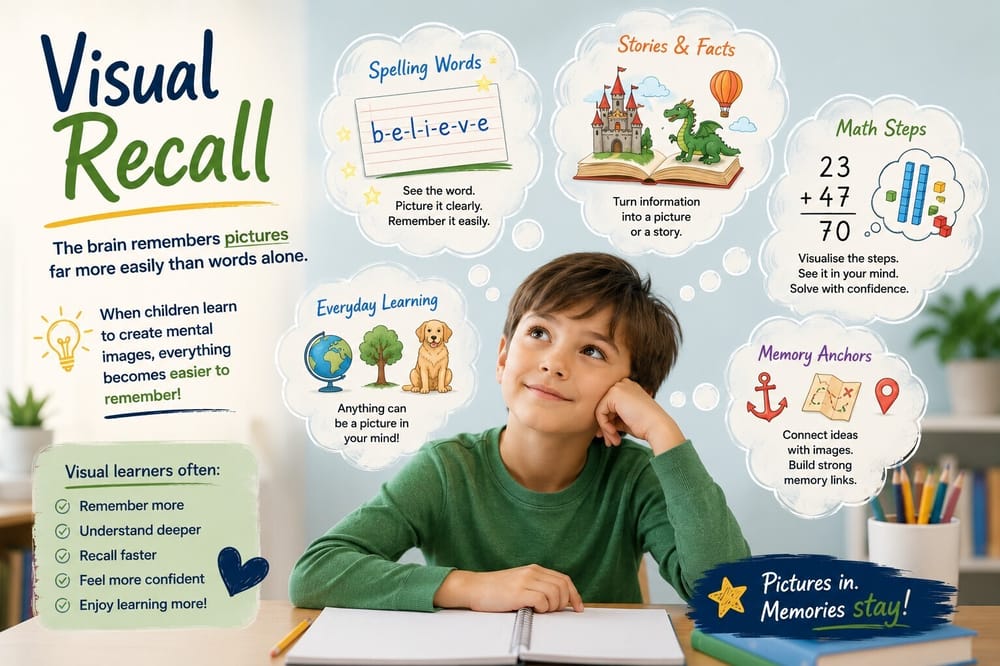
They often:
• see spelling words
• picture math steps
• imagine stories
• visualise information
They often:
• see spelling words
• picture math steps
• imagine stories
• visualise information
The brain remembers pictures far more easily than abstract information.
But many children are never taught how to use this ability intentionally.
Instead they are told to:
• repeat things
• memorise harder
• “just focus”
• keep rereading
Unfortunately, repetition without visual connection often fades quickly.
Children who learn to create mental pictures frequently improve:
• memory
• recall
• spelling
• reading comprehension
• confidence
The goal is not simply more effort.
The goal is learning in a way the brain naturally remembers.
LEARNING GAP #3
Hidden Learning Gap #3
Your Child May Never Have Learned HOW To Learn
This may sound surprising…
But many children are expected to learn without ever being taught:

• how memory works
• how to focus
• how to organise information
• how to retrieve information later
• how to learn in the way that suits them best
• how memory works
• how to focus
• how to organise information
• how to retrieve information later
• how to learn in the way that suits them best
Imagine being asked to play sport without learning the basic skills first.
- Learning works the same way.
- Children need strategies.
- When children understand:
• how their brain learns
• how to create memory links
• how to stay calm
• how to use visual tools
• how to recall information
Learning often becomes:
• faster
• easier
• less stressful
• and more enjoyable
Confidence begins to grow because success leaves clues.
A SIMPLE SHIFT YOU CAN TRY TODAY
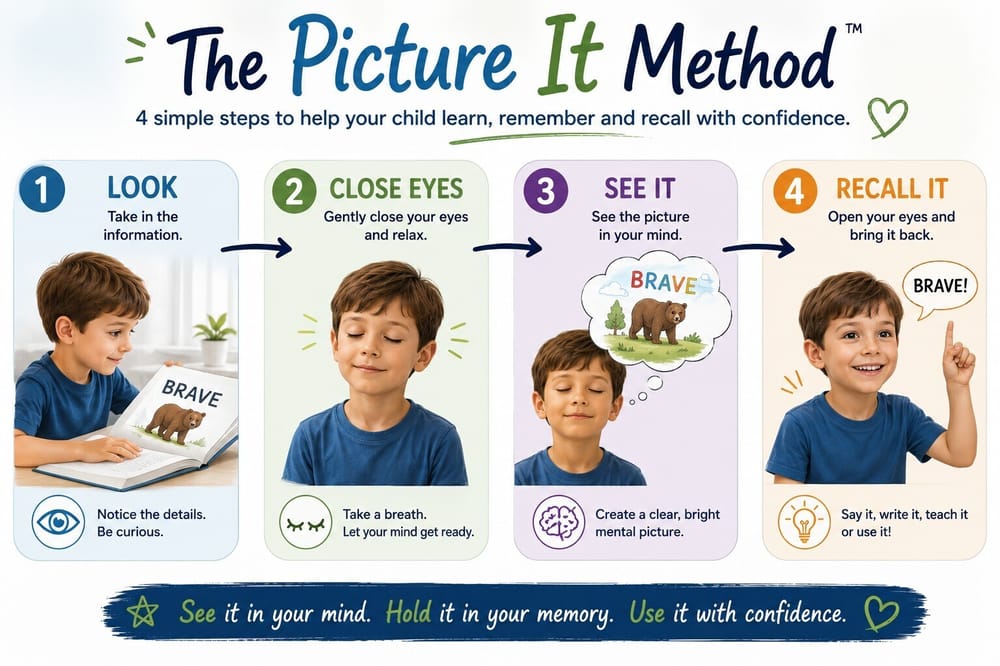
Here is a very simple strategy you can try with your child.
The “Picture It” Method
Here is a very simple strategy you can try with your child.
The “Picture It” Method
The “Picture It” Method
Instead of simply repeating a spelling word:
Step 1
Ask your child to LOOK at the word carefully.
make sure they have an image of the word .
Step 2
Close their eyes.
Step 3
Ask:
“Can you see the word in your mind?”
Step 4
Ask questions like:
• What colour is it?
• Which letter looks biggest?
• What does the beginning look like?
• Can you picture the whole word?
This simple process encourages the brain to use visual memory rather than only repetition.
Children are often amazed by how much easier recall becomes when they learn to “see” the information.
Small shifts can create big breakthroughs.
Your Child Can Learn With More Confidence ...
Every child can learn.
Sometimes they simply need:
• better tools
• calmer learning states
• stronger strategies
• and someone to show them how.
That is why I created the:
5 Step Easy Learning System
A practical, parent-friendly program designed to help children:
✅ improve focus
✅ strengthen memory
✅ increase recall
✅ build confidence
✅ reduce homework stress
✅ and discover HOW to learn more effectively
Because when children learn how to learn…
they often discover they are far more capable than they ever believed.
Ready To Help Your Child Learn With More Confidence?
Discover the 5 Step Easy Learning System today.
Your child’s future learning journey may begin with one simple shift.
About Dale McCormac
Dale McCormac has spent over 20 years helping children and parents understand how learning really works. With training in Neuro-Linguistic Programming, learning strategies, emotional support techniques, and educational development, Dale is passionate about helping children build confidence, self-esteem, and a lifelong love of learning through practical brain-based strategies.